And punish the sick

There’s been quite the brouhaha here over the last few days over the non-custodial sentences given to two women who attacked and injured a paramedic.  The case, if you’re interested, was Director of Public Prosecutions v Warren & Underwood [2018] VCC 689.  The public response has been predictably savage, and remarkably unforgiving when one considers that both women were (and are) apparently remarkably damaged after lifetimes of physical and sexual abuse.  Attempts by me to defend the decision were not well received –
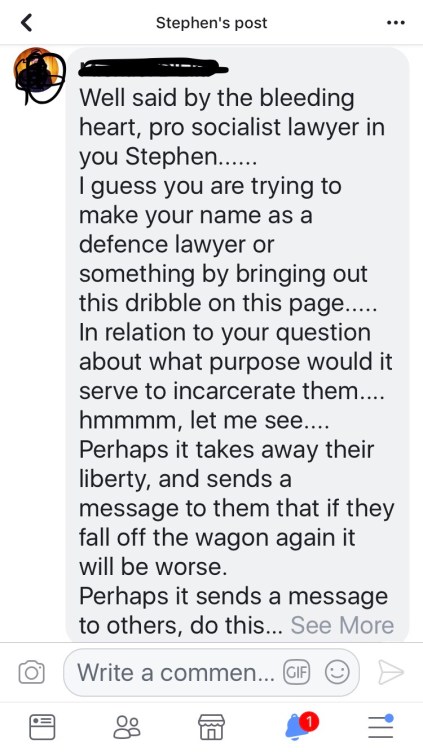
It’s a bit of a surprise to be called a “bleeding heart socialist” after a lifetime as an old-school right winger!

More troubling are the proposed reforms reported in yesterday’s Age, and in particular this one –

Ambulance Employees state secretary Steve McGhie said he was given an undertaking from the Premier that he would change laws to jail people who injure emergency services workers, even if they are suffering from mental illnesses including schizophrenic episodes.

I have a stake in this: I am an “emergency services worker” when I’m not being a lawyer (State Emergency Service, Coast Guard and Red Cross).  But I can’t stomach the idea that protecting me warrants effectively re-criminalizing mental illness.  It is too close to punishing for the sake of punishing.
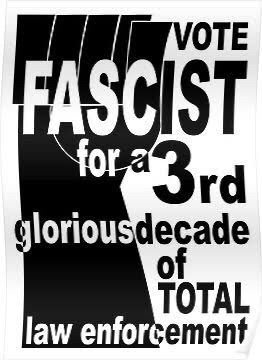
Image from here

I have to agree with Pope Francis: punishments which are imposed in the hope of frightening people into compliance – public punishments – are a hammer that makes every problem look like a nail:

a widespread conviction has taken root in recent decades that public punishment can resolve the most disparate social problems, as if completely different diseases could be treated with the same medicine. This is not so much about trust in some social function traditionally attributed to public punishment, as about the belief that it is possible that such punishment can obtain those benefits that would demand the application of a different type of social and economic policy as well as social inclusion.

A politician grubbing for votes by coming down hard on criminals is merely acting in a tawdry and predictable manner.  One who does so by coming down hard on the ill is repulsive.

Sometimes everyone loses

Sometimes nobody wins.

Harston
Image credit: Shepparton News

Mr Dajko was drinking on the night of 24 July 2016.  When he got in his car early the next morning he was tired and still had a blood alcohol concentration of 0.08.  A kangaroo hooped onto the road in front of him near Tatura, Australia.  He swerved to avoid it, lost control of his car and collided with a light truck, fatally injuring the driver.

The defendant was charged with exceeding the prescribed concentration of alcohol and with careless driving.  His ‘carelessness’ took the form of intoxication, fatigue and sudden swerving.  The Road Safety Act 1986 (Vic.) §65(1) provides that

A person who drives a motor vehicle on a highway carelessly is guilty of an offence and liable for a first offence to a penalty of not more than 12 penalty units and for a subsequent offence to a penalty of not more than 25 penalty units.

The defendant pleased guilty in Shepparton Magistrates Court.  Stuthridge M accepted that “this was an accident in the sense the kangaroo was involved and [the defendant] lost control of his vehicle”.  She also accepted that he was deeply troubled by the accident. Her Honour fined the defendant $1,000.00 and suspended his drivers licence for 16 months.

Police v Dajko (2017) Shepparton News, 29 August 2017, p.1.

Give up already.

It helps to know when to walk away.

broken window
Image from here

On 13 February 2018 a man in western Victoria, Australia, asked a family member to buy paint for him.  When they declined, he became angry and smashed windows in the family home and car.  He was charged with breaching §197(1) of the Crimes Act 1958 (Vic.):

A person who intentionally and without lawful excuse destroys or damages any property belonging to another or to himself and another shall be guilty of an indictable offence and liable to level 5 imprisonment (10 years maximum).

On 14 February 2018 the Hamilton Magistrates Court issued an intervention order directing him not to recontact a particular family member or to enter the family home.  Despite this, later in February he entered the home and became aggressive towards the family member.  The charge of breaching an intervention order was added to the prosecution.

The offender was presented for trial in Portland Magistrates Court and pleaded guilty.  He was fined $1,000.00 by Toose M.

Police v Bradley (2018) Portland Observer & Guardian, 2 May 2018, p.5

And it *was* bullshit!

It’s Friday, so it’s time to take a break from casenotes and share some stories.

Lawyers are fond of the self-image of Olympian detachment.  We don’t always live up to it, of course.  In a recent hearing I may have furiously snarled “oh, this is bullshit!” at opposing counsel in response to a particular line of argument.

bullshit
Image from here

It’s not new, of course.  Famously a courtroom fight between a court clerk and a lawyer in about 1705 resulted in the latter’s right forefinger bitten off: Cockroft v Smith (1705) 6 Mod. 230.  And last month a Californian lawyer was reported by the ABA Journal to have had the worst of litigation surrounding a punch-up with an investigator –

Jurors found Crawford and Alley were both liable for battery, and they were responsible for paying each other’s medical bills. The bills were $11,400 for Alley and $15,215 for Crawford. Jurors found that Alley did not use excessive force and did not violate Crawford’s right to free speech. …  Jurors imposed punitive damages based on its finding that Crawford had acted “with malice, oppression or fraud” against Alley.

All of which has me wondering: when have you seen red in the courtroom?  And how did it work out for you?

A shotgun won’t help

Grabbing the front passenger seat in a car can be accompanied by a cry of “shotgun”.  Sometimes it’s followed by a police officer saying “busted”.

shotgun_300x300
Image from here

On 24 December 2017 a driver in Rosebud, Australia, was driving home after a few celebratory glasses of champagne.  He encountered a police checkpoint and, while waiting, swapped seats with his (sober) wife.  This was observed by police, who asked him to take a breath test.  He was found to have a blood alcohol concentration of 0.055 (the legal limit being 0.05).

The driver was charged with breaching §49(1)(b) of the Road Safety Act 1986 (Vic.).  He was dealt with in Dromana Magistrates Court.  It was noted that he had two prior drink-driving charges.  Lethbridge M noted that a fourth charge was likely to result in imprisonment.  On this occasion he was disqualified from driving for 12 months and fined $750.00.

Police v Raymond (2018), Mornington Peninsula Leader, 1 May 2018, p.5.

Bringing a knife to a … dammit.

An old country song cautions against taking your guns to town.  That advice applies prudently to other weapons.

dont take guns
Image from here

On 11 June 2017 a man went to attend a rally by an Australian neo-Nazi group known as the True Blue Crew.  Victoria Police, anticipating conflict, had declared the area to be a “designated area”, giving them expanded search powers.  The Control of Weapons Act 1990 (Vic.), §10G(1) states that –

A police officer may, without a warrant, stop and search a person, and search any thing in the possession of or under the control of the person for weapons, if the person and, if applicable, the thing are in a public place that is within a designated area.

The accused’s car was searched, with a flick-knife and knuckledusters being found.  The report is slightly unclear but is appears he was charged with possessing a prohibited weapon in breach of §5AA of the Act.

The defendant pleaded guilty in the Dandenong Magistrates Court, claiming to have forgotten the weapons were in his vehicle.

Vandersteen M noted that the defendant suffered from a psychiatric condition, but also noted that he had a prior weapons conviction and was attending a rally by a racist organization.  The defendant was sentenced to a 12 month good behaviour bond with a condition that he continue to receive psychiatric treatment.

Police v Martin (2018), Endeavour Hills, Hallam and Doveton Star-Journal, 23 April 2018, p.3

You, sir, are an object lesson

The creators of South Park were quite right:

mackie
Image from here

On 18 March 2018 Mr Pearce’s vehicle was searched by police in Victoria, Australia.  The search turned up a cornucopia of drugs including cannabis, methamphetamine, cocaine and ecstasy.  It was found that he was already wanted for other driving and drug offences.

Mr Pearce was charged with a range of drug and driving offences, as well as a charge of breaching a community corrections order for still other drug offences.  His matter was dealt with in Frankston Magistrates Court.

At trial the defendant pleaded guilty and submitted that his life had “spiralled out of control” due to drug addiction and relationship failure.  Crisp M sentenced the defendant to 10 months imprisonment and imposed a fine of $2,200 and a five year  driving ban.

Police v Pearce (2018), Mornington Peninsula Leader, 24 April 2018, p.5.

When was it written?

Everyone deserves a fair hearing.  Even oil companies.

In April 2013 a North Sea oil processing station operated by Chevron was visited by a Health and Safety Inspector.  The inspector determined that the stairway accessing the helideck had become so corroded that it presented a danger to people on the facility.  He issued a prohibition notice under §22 of the Health and Safety at Work Act 1974 (UK), (Act) forbidding Chevron from carrying out certain activities at the station.

Bilfinger-Salamis-Secures-Work-on-Chevrons-North-Sea-Platforms
Image from here

Chevron appealed to the Employment Tribunal at Aberdeen under §24 of the Act.  Subsection 24(2) provides that –

A person on whom a notice is served may within such period from the date of its service as may be prescribed appeal to an employment tribunal; and on such an appeal the tribunal may either cancel or affirm the notice and, if it affirms it, may do so either in its original form or with such modifications as the tribunal may in the circumstances think fit.

On appeal, Chevron sought to rely on an expert report showing that the metalwork posed no threat to personnel.  The English Court of Appeal had previously held in Hague v Rotary Yorkshire Ltd [2015] EWCA Civ 696 that in such an appeal, the Tribunal was limited to considering the evidence available to the Inspector issuing the notice.  Despite this, the Tribunal considered that it was able to consider the later report supplied by Chevron and cancelled the notice.  An appeal by Chevron to the Scottish Court of Session was dismissed.  Chevron appealed to the Supreme Court of the United Kingdom.

For the Supreme Court, Lady Black pointed out that “[t]he appeal is not against the inspector’s opinion but against the notice itself”.  It followed that the Hague case had been wrongly decided and that is was open to the Tribunal on an appeal to consider all the available evidence, including evidence coming to light after service of the notice.

HM Inspector of Health & Safety v Chevron North Sea Ltd [2018] 1 WLR 964

Peyrou c. Nivelle (Tribunal of Paris, 20 July 1792)

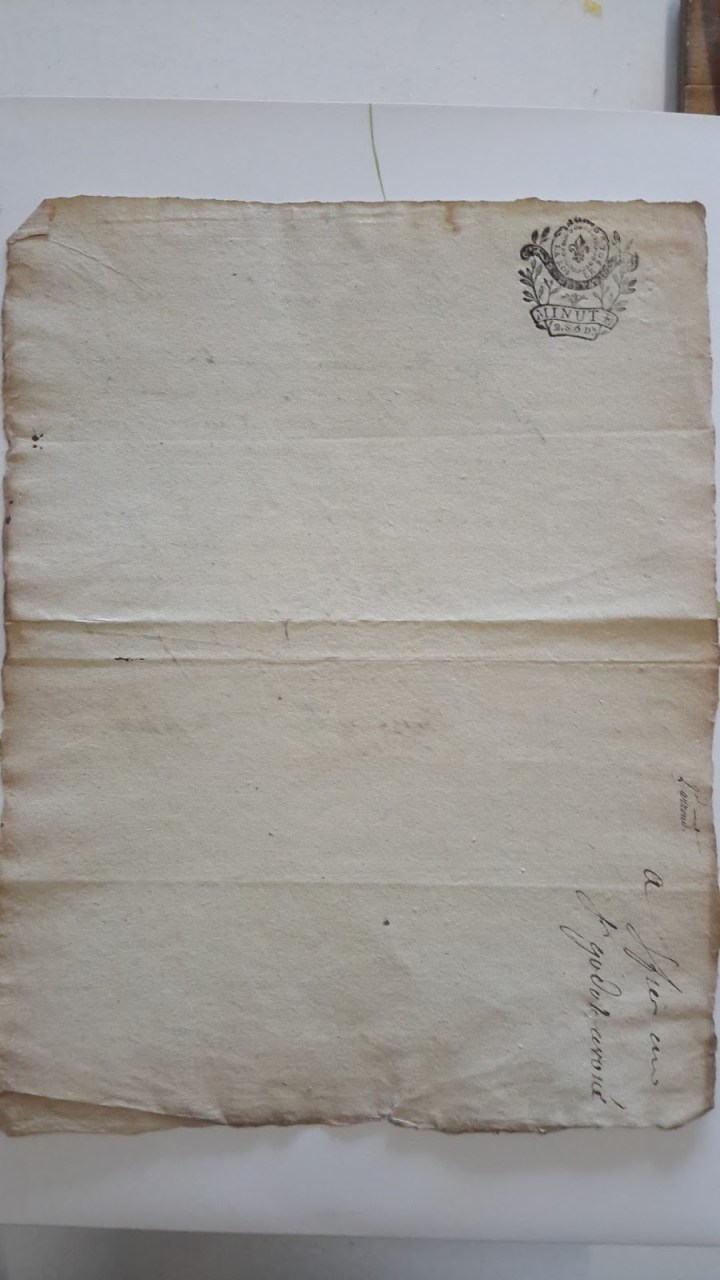
In 2015  I bought a legal document from the French ancien regime on eBay for the princely sum of $10.00. I recently translated it.  I thought it may be of interest to other lawyers.

Document

French Court Doc page 1French Court Doc page 2

Translation

Translation was not straightforward: The script is hard to read and words often run into each other. In addition, a number of the words appear to be French legalese or archaic (or both). Often accents are not where one would expect them to be.

I have transcribed and translated the document line by line below. Doubtful points are marked by asterisks and question marks. Interpolations and educated guesses are marked by square brackets.

Front

Le S[eigneu]r Dourif avoué en tribunal de Paris

Lord Dourif solicitor in the Tribunal of Paris

Declare au Jean Godot avoué du Citoyen Nivelle

Declares to Jean Godot solicitor for Citizen Nivelle

Que sans aucune approbation prejudicielle

That without any prejudicial consent

et sous touttes [sic] reserva de droit meme de demandes

And under all [reservations?] of law and also of claims

la nullite de l’assignation et accupera[?] pour le

the nullity of the summons and ******** for the

jean[?] peyrou ancien negotiant à paris sur l’assignation

Jean Peyrou former trader at Paris on the summons

à la Donnée au tribunal du de*reme arrondissement

at the [finding?] of the tribunal of the [2nd?] district

du Department de Paris aus funde requete

of the Region of Paris *** ***** request

et ordonnance des place des quinces fermès derniers

and judgment of the place of the ******* ****** last

*** novembre prefere **if à requie n’ent

*** November prefers **** to ****** *’***

ignore du *** acte.

ignores from the *** act.

F. Donnet Bourgeois De eglucerne [Signature?]

F. Donnet gentleman of *********

**u au * Godot afre*e le

*** of the Godot ****** the

vingt j[ui]l[le]t[?] 1792 [Signature?]

20 July 1792

Back

[Stamp:] La loi le roi

The law, the king

D[epartment] de Paris

D[epartment] of Paris

Minute

Minute / note

2.S.6.D.

2 sols 6 deniers [probably the filing fee].

[Handwritten:] L’arrond’

The dist.

a *ier au

to **** to the

J Godot avoué

J Godot solicitor

Context and Comment

This document appears to be a waiver of a claim (or part of a claim) between a trader named Peyrou and a man named Nivelle, or perhaps a waiver of the benefit of a procedural point. Presumably the dispute was a commercial one.

The document is a good artefact from its time. The seal marked La loi, Le Roi is appropriate for the date 1792: at that time the motto of the Kingdom of France was La Nation, la Loi, le Roi.

685px-Coat_of_arms_of_France_1790-92.svg
Alternative Royal Arms of France 1789–1792 (Image from here)

The conventional date “20 July 1792” would not long continue: on 22 September 1792 the Republican calendar recommenced with Year I. I’m intrigued that the document seems to use both the titles “Seigneur” (Lord) and Citoyen (citizen).

I have no idea of the current value of the filing fee of 2 sols 6 deniers.  It could have been (and perhaps was) paid using coins:

2 sols
2 sols (Image from here)
6 deniers
6 deniers (Image from here)

Looking at the rest of that year, one notes that in 1792 France entered upon wars with Austria and Prussia, that the Paris mob stormed the Tuilleries and conducted the September massacres, and that the trial of King Louis XVI commenced. This document is a useful reminder that even when the great events of world history occur, ordinary men and women still go on earning a living and leading a life.

The worst of ideas

A week or two ago I wrote about a case of manslaughter-by-neglect in Florida where the defendant was not imprisoned. A recent case out of Texas suggests that State will take a harsher view of failure to care for another person.

1525117864-cynthia-marie-randolph
Cynthia Randolph (Parker Co. Sheriffs Office)

On 26 May 2017 Cynthia Randolph of Fort Worth, Texas became angry with her two children (aged 1 and 2 years). They were playing in her car and refused to get out. She left them in the car to “teach them a lesson”. She returned to her house, watched televison, smoked some marijuana and napped for a few hours. It is estimated that in that time the temperature in the care reached 140F (60C). When she woke, the children were unresponsive.  They died shortly afterwards.

Randolph was charged with two counts of intentionally causing serious bodily injury to a child, punishable by up to 99 years imprisonment. The jury had the option of convicting her of (inter alia) recklessly causing serious injury. Texas Penal Code §22.04(a) states that –

A person commits an offense if he … recklessly… by act or … recklessly by omission, causes to a child…:
(1) serious bodily injury;
(2) serious mental deficiency, impairment, or injury;  or
(3) bodily injury.

Randolph’s matter was heard in the 415th Texas District Court before Judge Quisenberry The jury opted to convict on the lesser charge, but imposed the maximum term of 20 years imprisonment in respect of each child.

State v Randolph (2018), Dallas Morning News, 1 May 2018; CBS News, 1 May 2018; Sacramento Bee, 1 May 2018; New York Post, 30 April 2018; KVUE, 30 April 2018