Casablanca-on-the-Brazos: the decision in Dejoria v Maghreb Petroleum Exploration SA

David Coale at Lynn Tillotson Pinker & Cox has put up an interesting casenote on the recent Fifth Circuit decision of Dejoria v Maghreb Petroleum Exploration SA.  The decision looks at the requirements for Texas courts to decline to recognise judgments of foreign courts.

I imagine many courts in the Western world would be very reluctant to refuse to recognise judgments from courts in the third world without strong evidence that the decision in issue was (in effect) a figleaf for simple expropriation.  There may be a cautionary tale for them in the opprobrium heaped on the decision of In Re Southern Rhodesia [1919] AC 211.  In that case the Privy Council said that –

Some tribes are so low in the scale of social organization that their usages and conceptions of rights and duties are not to be reconciled with the institutions or the legal ideas of civilized society. Such a gulf cannot be bridged.

Arguments over which societies and societies are barbaric and which are civilised makes for a fun (if fairly Arts-Faculty-common-room) parlour game.  The need to decide which Courts are capable of acting fairly and which are not may be one of the only places where that debate perhaps still has teeth.

Graeske v R (2015) H&FLR 2015-36

Joshua Graeske v The Queen (2015) H&FLR 2015-36

Court of Appeal of Victoria

28 August 2015

Coram: Maxwell P and Whelan JA

Appearing for the Appellant: Ms CA Boston and Mr A Imrie (instructed by Melasecca Kelly & Zayler)
Appearing for the Respondent: Ms D Piekusis (instructed by Ms V Anscombe, Acting Solicitor for Public Prosecutions)

Catchwords: Australia – Victoria – Australian football – assault – sentencing.

Facts: On 14 July 2012 the defendant (then aged 21) was playing football in an amateur match.  During the match he pulled an opponent to the ground and punched him a number of times, causing significant facial injuries.  He was charged with recklessly causing serious injury (Crimes Act 1958, §17).

The defendant pleaded guilty to the charge and was sentenced to be imprisoned for three years, to serve a minimum of two years: DPP v Graeske (County Court of Victoria, Judge Wischusen, 7 November 2014, unreported).  During the course of the hearing the Sentencing Amendment (Emergency Workers) Act 2014 commenced, the effect of which was (in part) to allow terms of imprisonment to be combined with community corrections orders. Due to an apparent oversight, neither the prosecution nor the defence addressed these amendments in their submissions to the court.

The defendant appealed against the sentence imposed.

Held: Allowing the appeal, setting aside the original sentence and re-sentencing the appellant, that –

1. Because no submissions were made in light of the Sentencing Amendment (Emergency Workers) Act 2014, the trial judge inevitably misdirected himself as to the available sentencing options.

2. Noting the appellant’s youth, difficult personal history and other factors, a sentence of imprisonment for one year followed by a community corrections order of three years (geared to address the appellant’s mental health and drug problems) was appropriate

Judgment

The Court’s judgment is available here.

Marks and Johnson v Scottsdale Ins. Co. (2015) H&FLR 2015-35

Danny Ray Marks and Timothy B Johnson v Scottsdale Insurance Company (2015) H&FLR 2015-35

United States Court of Appeals (Fourth Circuit)

29 June 2015

Coram: Hamilton, Sen. Cir. J.; Gregory and Harris, Cir. JJ.

Appearing for the Appellant (Marks): John Janney Rasmussen (of Insurance Recovery Law Group).
No appearance for the Plaintiff (Johnson).
Appearing for the Appellee: Mr John Becker Mumford (of Hancock, Daniel, Johnson & Nagle)

Catchwords: Virginia – insurance law – coverage – hunting – hunt club – members – vicarious liability.

Facts: Mr Johnson was a member of the Northumberland Hunt Club.  On 3 January 2013 he was hunting on land leased by the club which was adjacent to a roadway.  He fired a shot which struck and injured Mr Marks, a passing motorist.

Marks commenced proceedings in negligence against Johnson and the Club in a Virginia court.  He issued separate proceedings against the Scottsdale, seeking a declaration that that company was obliged to defendant and indemnify Johnson. The relevant insurance company covered the Club and “any of [its] members, but only with respect to their liability for [the Club’s] activities or activities they perform on [the Club’s] behalf”.

Scottsdale successfully aplied to transfer the matter to a federal court, which found that Scottsdale was not obliged to defend or indemnify Johnson: Marks and Johnson v Scottsdale Ins. Co. (US Dist. Ct for E.D. Va, Novak Mag.J., 30 July 2014, unreported).  Mr Marks appealed.

Held: Dismissing the appeal,that –

1. Virginia law requires the contract’s words to be given their “ordinary and customary meaning”.

Salzi v Va Farm Bureau Mut. Ins. Co, 556 SE.2d 758 (Va. 2002), followed.

2. Coverage of liability for “the Club’s activities” restricts coverage to the member’s vicarious liability for activities the club as an entity undertakes (for example, entering contracts or buying or selling property).  Members are however not covered with respect to their actions “during in connection with the club’s activities”.  In this case, no facts were alleged against Johnson which (if proved)would render Scottsdale liable to defend or indemnify him.

Lenox v Scottsdale Ins. Co. (US Dist Ct for Dist of NJ, Chesler Mag.J., 5 May 2005, unreported); CACI International Inc v St Paul Fire and Marine Ins. Co., 566 F.3d 150 (4th Cir., 2009), followed.

Judgment

The Court’s judgment is available here.

Ships of North Korea

A news report yesterday from North Korea’s K.C.N.A. news agency said that –

The Nampho Marine Transport Company in the D.P.R.K. has recently laid down a new solar passenger ship.  This twin-hull ship, completely based on solar power, will run between Nampho City and North and South Hwanghae provinces.  It is expected that the existing passenger ships can be remodeled into solar-powered ones

Does anyone else remember how Clive Palmer announced that he was going to rebuild the Titanic … and how that project quietly went down the memory-hole?  Apparently even the North Koreans can come up with more plausible ideas than ol’ Clive

Powers of VICSES members

The State parliament is considering the Emergency Management (Control of Response Activities and Other Matters) Bill 2015 (Amending Act). It may be of interest to SES members.

  1. Status

The bill’s second reading was moved in the Legislative Assembly on 14 August 2015. This note assumes it will become law without amendment.

  1. Powers

If a word is bolded, I have included a definition or commentary under heading 2.3.

2.1  Entry Power

Section 27 of the Amending Act amends the Victoria State Emergency Service Act 2005 so that a person may enter land or premises without the consent of the occupier if a Service member reasonably believes that entering is urgently required to protect life or property in the course of –

(a)  responding to or preparing for a flood, earthquake or storm; or

(b)  providing a rescue service.

2.2  Levee Power

Under the Amending Act, if the power to enter is exercised, the person entering may build, remove or alter a levee at that location, or remove debris (including fallen trees) if a Service member reasonably believes that doing so is required to protect life or property. As soon as practicable after the threat has passed any levee must be restored (or removed) so to return the land to its pre-existing condition, unless the change in condition was damage caused by the emergency itself.

The power to create, remove or alter levees can be exercised on private property and also on –

(a)  Crown land;

(b)  land which is reserved under the Crown Land (Reserves) Act 1978 or the Forests Act 1958;

(c)  a national park, State park, marine national park, marine sanctuary or land that is otherwise a park under the National Parks Act 1975;

(d)  land that is a State Wildlife Reserve or a Nature Reserve under the Wildlife Act 1975;

2.3  Definitions

“person” – This can be either a VICSES member or any other person who voluntarily places their services at the disposal of VICSES’s chief offer, operations and is acting under the direction of a VICSES member.

“occupier” – It would be interesting to consider whether one could enter if an owner of lands installed a sign stating “no entry by emergency services without prior permission”.

“Service member” – This includes paid, operational and probationary VICSES members.

“reasonably believes” – This means that the belief would be held by a reasonable person (or, more likely, a reasonable SES member) in the circumstances, and not that the individual concerned thinks that their belief is reasonable.

”flood, earthquake or storm” – Curiously, by implication this excludes tsunamis for which VICSES is the control agency.

  1. Obligations

If a word is bolded, I have included a definition or commentary under heading 3.3.

3.1  Notification

If the power to enter without consent is exercised, the occupier of the land or premises must be notified in writing of the entry and actions taken within 7 days.

3.2  Liability

Emergency response activity involving levees may create a risk of civil liability. Section 16 of the Water Act 1989 says that –

(a)  If water flows from a person’s land to any other land, and that flow is not reasonable, and injury/damage/economic loss occurs, then the person who caused the flow is liable to pay damages.

(b)  If a person

(i)  interferes with a reasonable flow of water onto any land; or

(ii) negligently interferes with a non-reasonable flow of water onto any land

and due to the interference water causes injury, damage or economic loss, then the person who interfered with the flow is liable to pay damages.

Section 20 of the Water Act 1989 lists a number of matters to be considered in assessing whether a flow of water is reasonable or not reasonable. The Amending Act states that if a flow of water caused by VICSES action in relation to a levee is in issue, whether or not that action was in response to an emergency must be given greater weight than any other factor.

3.3  Definitions

“negligently” – Relevantly here, a person would be acting negligently if they fail to exercise the level of care that a reasonable person (or reasonable SES member) would exercise in all the circumstances.

Patsuris v Gippsland & Southern Rural Water Corporation (2014) H&FLR 2015-34

Tom Patsuris v Gippsland & Southern Rural Water Corporation (2014) H&FLR 2015-34

Supreme Court of Victoria

15 December 2014

Coram: McDonald J

Appearing for the Appellant: P. Cawthorn QC and B. Miller (instructed by Morrison & Sawers)
Appearing for the Respondent: R. Sadler (instructed by DLA Piper)

Catchwords: Australia – Victoria – water law – administrative law – food production – irrigation – infrastructure – rainfall – flooding – compensation

Facts: The Appellant operated a market garden at Werribee South.  His land was irrigated by a system of channels managed by the Respondent.  The channels funnelled water into a network of drains which directed the water away from the land.  In 2010 a new culvert was installed in one of the drains (and off the appellant’s land) to allow access to the property of a third party.  The respondent mandated the design parameters of the new culvert such that it would cater for a 1 in 50 year rainfall event.

In February 2011 rainfall occurred which was in excess of a 1 in 100 year event.  The appellant’s land was flooded causing significant loss and damage.  The appellant brought proceedings against the respondent under the Water Act 1989 (Vic), §157.  That section relevantly provides that –

(1)     If —

(a)     as a result of intentional or negligent conduct on the part of [a water] Authority in the exercise of a [statutory] function …, a flow of water occurs from its works onto any land; and

(b)     the water causes —

(i)     injury to any other person; or
(ii)     damage to the property (whether real or personal) of any other person; or
(iii)     any other person to suffer economic loss—

the Authority is liable to pay damages to that other person in respect of that injury, damage or loss.

(2)     If it is proved in a proceeding brought under subsection (1) that water has flowed from the works of an Authority onto any land, it must be presumed that the flow occurred as a result of intentional or negligent conduct on the part of the Authority unless the Authority proves on the balance of probabilities that it did not so occur.

(3)     For the purposes of a proceeding brought under subsection (1)—

(a)     a flow of water is to be taken to have occurred as a result of intentional conduct on the part of an Authority if the flow—

(i)     was designed or intended by the Authority; or
(ii)     inevitably and without intervening cause resulted from the exercise of a power by the Authority; and

(b)     in determining whether or not a flow of water occurred as a result of negligent conduct on the part of an Authority, account must be taken of all the circumstances including any omission or failure, in the planning, design, construction, maintenance or operation of the works, to provide reasonable standards of capacity or efficiency or exercise reasonable care or skill having regard to the following matters—

(i)     the state of scientific knowledge and knowledge of local conditions at any relevant time;
(ii)     the nature and situation of the works;
(iii)     the service to be provided by the works;
(iv)     the circumstances and cost of—

(A)     the works; and
(B)     the maintenance and operation of the works; and
(C)     works which it would have been necessary to construct to avoid the occurrence of any relevant injury, damage or loss.

The appellant’s claim was rejected at first instance: Patsuris v Gippsland & Southern Rural Water Corporation (Victorian Civil & Administrative Tribunal, S.M. Riegler, 14 October 2013, unreported).  The Tribunal found that –

(a) It was not reasonable to require the respondent to have designed its drainage and irrigation systems to cater for a rainfall event of greater than 1 in 100 years.
(b) The appellants land had been flooded because the water runoff could not discharge rapidly enough through two culverts (other than the new culvert, which did not cause the flooding).
(c) The severity of the storm meant that such reverse flow of water as occurred would have taken place regardless of the new culvert.

The appellant appealed to the Supreme Court of Victoria seeking judicial review of the decision.

Held: Dismissing the appeal, that –

1. For the purposes of an application for judicial review, to establish that a finding of fact was not open to a decision maker it must be established that there was no evidence to support the disputed finding.

Myers v Medical Practitioners’ Board of Victoria, 18 VR 48 (Vic., 2007), considered.

2. Under §157 a flow of water is deemed to have occurred as a result of a water corporation’s intentional conduct if the corporation designed or intended the flow or it inevitably and without intervening cause resulted from the corporation’s exercise of power.  However, the fact that a corporation’s conduct in approving the design of a culvert was intentional does not in itself support a conclusion that a flow of water was caused by that conduct: there must still be evidence that the design caused the relevant flooding.

State Rivers & Water Supply Commission v Crea [1980] VR 513 (Vic., 1979), considered.

3. A claim under §157 is a freestanding cause of action.  There is no independent duty of care in accordance with common law principles arising under the tort of negligence*.

South East Water Ltd v Transpacific Cleanaway Pty Ltd, 27 VR 387 (Sup. Ct. Vic., 2010), followed

Judgment

The Court’s judgment is available here.

Note

Quaere whether it is still possible to claim in negligence for harm arising from the flow of water caused by the act of a water authority.

History in a Corner?

Many, many writers have been commenting on the emerging course in “Advanced Placement – United States History”. I have been fascinated to follow the debate in the journal Perspectives on History. Viewing the discussion as an outsider, I think that the conservative side of the argument is painting itself into a corner.

Recent reports in the Patriot Post and CNS News have outlined the conservative position. It is stated that they accept that American history can have its flawed and unflattering points, but that the proposed AP framework threatens to overemphasise these flaws at the expense of the grand and ennobling story.

I tested the line of argument by considering the reliably conservative Patriot’s History of the United States in relation to the war against Japan (1941-5). Chapter 17 discusses the war as part of the United States’ involvement in the Second World War, and this focus on the American experience is certainly proper given its stated focus. In this context, it is not surprising that it does not discuss how the population of east Asia viewed the war, save for observing that –

In its relentless march of conquest, Japan had grabbed more territory and subjugated more people than any other empire in history and, for the most part, had accomplished all this in a matter of months …

Consistently with this, the chapter is titled “Democracy’s Finest Hour”. The problem with this approach to the history is that it is simply misleading as a direct result of not considering the experiences of “others” (like Asians, commoners, non-soldiers). When these perspectives are considered one finds that the Japanese were frequently welcomed (at least initially) by native populations as liberators from Dutch and French imperial masters (1). The war against Japan, then, can be considered less as a war for democracy and more as a war to re-establish a colonial order. By leaving out evidence that tends to such a conclusion and not addressing it, a highly fragile history is built that can be discredited with new information. Conservatives in such a case put themselves in the position of needing to admit error or to defend the indefensible.

================================

(1) Sebastian Conrad and Prasenjit Duara, Viewing Regionalisms from East Asia (Washington DC, 2013) at p.23; Ethan Mark, ‘The Perils of Co-Prosperity: Takeda Rintaro, Occupied Southeast Asia, and the Seductions of Postcolonial Empire’ (2014) 119 American Historical Review 1184.

On the Centenary of Anzac Day

Oceans of ink and hurricanes of breath have been expended parsing the centenary of the Anzac landings in recent months.  Much of it has been platitudes about sacrifice; some of it has involved historically problematic claims of defending ‘our’ freedoms.  All of it has laboured under the ancient difficulty of extracting meaning from the terrible slaughter of the First World War.

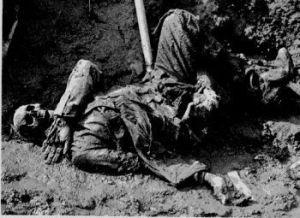
Skeleton trench

I suggest that the reason people both at the time and now struggle to make sense of the vast human toll of the Great War is because the principle it was fought to defend seems so insubstantial.  In the end, for the British Empire at least, it was a war for the rule of law.

The United Kingdom’s stated reason for entering the war was the defence of Belgian neutrality.  In 1839 Germany signed the Treaty of London which created the Kingdom of Belgium, with that Kingdom recognised as remaining a neutral power.  It was that promise of neutrality which the German Empire intended to violate by executing the Schlieffen Plan in order to inflict a rapid defeat on France.

Treaties – promises between nations – are a form of law: ultimately they are a promise by a sovereign to behave in a particular way, in the same way that an Act of Parliament is a promise that some behaviour (like murder) will not be countenanced.  By making war on Belgium, the German Empire repudiated its sovereign promise.  Britain’s acceptance of this as a cause for war declared that it was willing to shed blood to maintain the rule of international law.  Its willingness to endure horrendous bloodshed in this cause was a firm demonstration that the rule would not be violated with impunity (1).

I think that the reason the sacrifice of the Great War seems meaningless today is that the principle that sovereignty is not unlimited is now taken for granted: the sovereign power of making war (or of “making die”) (2) that President Hussein sought to exercise with the annexation of Kuwait in 1990 prompted Security Council resolution 678 and ultimately resulted in the Persian Gulf War.  At present a long-running dispute between Nicaragua and Costa Rica over the location of their border has lead not to a call to arms or a gallant defence of the Fatherland, but to proceedings in the International Court of Justice.

It is for this reason that I find the hostility to international courts of William Safire (3) and Ted Cruz (4) to be somewhat concerning.  These courts are a sign that law is accepted to exist at an international level, and that state sovereignty ought conform itself to it – precisely the principle for which the British Empire went to war.  Courts like the International Court of Justice – slow, procedure-heavy, grindingly technical, unexciting – are the lasting monument to the courage and suffering of the British- and Mediterranean Expeditionary Forces.  I can think of few greater gifts to the people of the world.

================================

(1) An interesting ‘what if’ is whether Britain would still have entered the war against Germany. Personally I think it would: the potential gains in the form of not allowing a single power to dominate Europe, and the promise of territorial gains for New Zealand, Australia and South Africa, would ultimately have been too great a temptation for the Empire to remain aloof.

(2) Sophie Wahnich, In Defence of the Terror (trans. D. Fernbach) (2012), at 58-59.

(3) William Safire, ‘The Purloined Treaty’, New York Times (9 April 2001) at np.

(4) Ted Cruz, ‘SCOTUS rejects authority of World Court’, Human Events (1 April 2008) at 1.

Fitness and Economics

A few interesting news stories have recently caught my eye that have made me think about the economic impacts of fitness-oriented policies.

One was a report in The Tennessean about the relocation of Beretta USA’s manufacturing to Tennessee.  Beretta’s reputation leans heavily towards sporting firearms, and this seems to dovetail with a sympathy in a number of southern American states to outdoor sports (and with an antipathy in those same states to gun control).  A pro-outdoor sports policy, then, can have benefits for investment in a region.  It can also incentivize the promotion of environmental benefits, although this may or may not support economic growth.

The construction of infrastructure like rail-trails is another source of direct investment which has the potential for corollary benefits in a healthier populace and a more productive and stable workforce.  That said, promoting these outcomes may have other (perhaps more immediate negative economic impacts: For example, advertisements about the dangers of highly-sweetened drinks (and doubts as to the merit of diet drinks) may be expected to affect manufacturers of these products in a negative way.  Further, promoting healthy foodstuffs like melons may both encourage economic activity while worsening overall labour standards.

Fitness initiatives, then, can be said to have great potential for economic benefits but must be carefully calibrated not to create extra problems.

Pennsylvania v Gosselin (2004) H&FLR 2015-33

Commonwealth of Pennsylvania v Barbara Gosselin (2004) H&FLR 2015-33

Superior Court of Pennsylvania

5 November 2004

Coram: Hudock and Klein JJ; McEwen PJE

Appearing for the Prosecution: No appearance
Appearing for the Defendant: Dick Berger

Catchwords: Pennsylvania – pets – squirrel – wildlife – marking

Facts: The defendant was a resident of South Carolina in the early 1990s.  While a resident there she took into her care an injured squirrel which became the family pet.  In 1994 the defendant, her husband and the squirrel relocated to Pennsylvania, where the squirrel was housed in a room-sized enclosure.  In 2002 an officer of the Pennsylvania Game Commission became aware of this and requested that the squirrel be released into his charge on the basis that it was unlawful to keep it in this manner.  The defendant declined to release the squirrel and was charged with unlawfully possessing wildlife.

Section 2307 of the Pennsylvania Game and Wildlife Code (34 Pa CSA §2307) relevantly provides that –

(a) It is unlawful for any person to … possess … any … wildlife contrary to the provisions of this title.

(c) Nothing in this title shall prohibit the possession … of … wild animals lawfully taken outside of [Pennsylvania] which are tagged and marked in accordance with the laws of the state or nation where the … wild animals were taken. It is unlawful to … possess … wild animals from another state or nation which have been unlawfully taken, killed or exported.

It was common ground that the squirrel was a wild animal and that South Carolina law allowed the taking and domestication of squirrels without requiring them to be tagged or marked.

The defendant was convicted of the charge and fined $100.00: Pennsylvania v Gosselin, Morning Call, 14 May 2003 (Orwigsburg Dist. Ct., Feb. 2003).  She appealed to the Court of Common Pleas which upheld the conviction: Pennsylvania v Gosselin, Morning Call, 28 November 2003 (Schuykill Co. Ct. Comm. Pleas, Nov. 2003).  She further appealed to the Superior Court.

Held: Allowing the appeal and dismissing the charge, that because South Carolina law did not require the squirrel to be tagged or marked, the absence of tagging or marking met the requirements of §2307(c).  Because it was agreed that the squirrel was lawfully taken in South Carolina, the exception in paragraph (c) was made out.

Judgment

The Court’s judgment is available here.